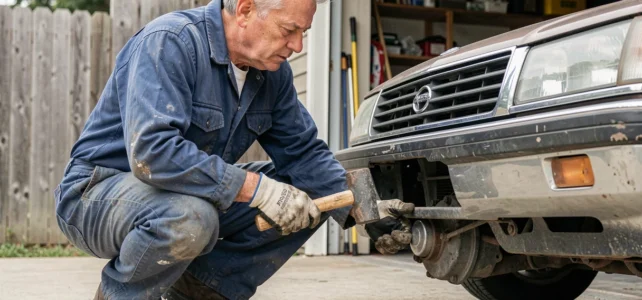
One morning, the ignition turns without engaging. The dashboard lights up normally, the indicators respond, but the engine refuses to start. When the battery is not the issue, the starter remains the main suspect. Before calling a tow truck, an emergency troubleshooting technique involves hitting the starter to free its internal components. This method has its limits and risks, and the exact location of the hit matters as much as the force applied.
Stuck solenoid or worn brushes: identify the real problem before hitting
Hitting a starter does not work in all cases. The technique only makes sense if the blockage is mechanical: a stuck solenoid, brushes stuck on the commutator, or a drive gear that no longer engages with the flywheel ring.
The telltale symptom is a sharp “click” when you turn the key, followed by silence. This noise indicates that the solenoid is trying to activate but is not succeeding completely. If you hear nothing at all, the problem is likely upstream (relay, wiring, or a genuinely dead battery).
Before any intervention, it is useful to know where to hit the faulty starter correctly, as a poorly placed hit can damage the solenoid or the starter housing without solving anything. The distinction between a mechanical blockage and an internal electrical failure changes everything: in the latter case, hitting will be of no use.
Locating the starter based on engine type
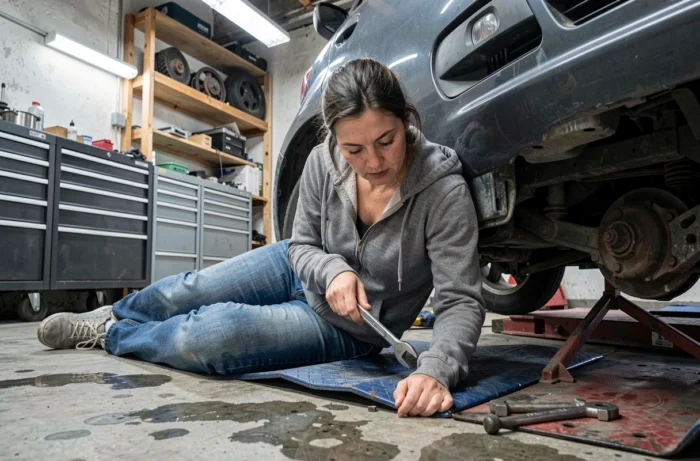
The starter is located at the junction between the engine and the transmission. On most front-wheel drive vehicles with a transverse gasoline or diesel engine, it is mounted at the back of the block, on the firewall side. On longitudinal engines (rear-wheel drive, some German models), it is located lower down, often accessible from underneath.
To locate it without experience, follow the thick positive cable that comes from the battery. This cable connects directly to the solenoid terminal, which is mounted on top of the starter. The solenoid is the smaller cylinder attached to the main body.
Access from above or below
On many compact cars (Clio, C3, 208), the starter is partially obscured by the intake manifold or hoses. You can sometimes reach it by reaching your arm from above the engine compartment. On other vehicles, lifting the car with a jack and removing an under-engine shield will be the only option.
Vehicles with a rear-mounted transmission (Porsche, some Subarus) present an additional accessibility issue: the starter is mounted on the transmission housing, far from the front engine compartment.
Hitting technique on the starter: gesture, tool, and contact area
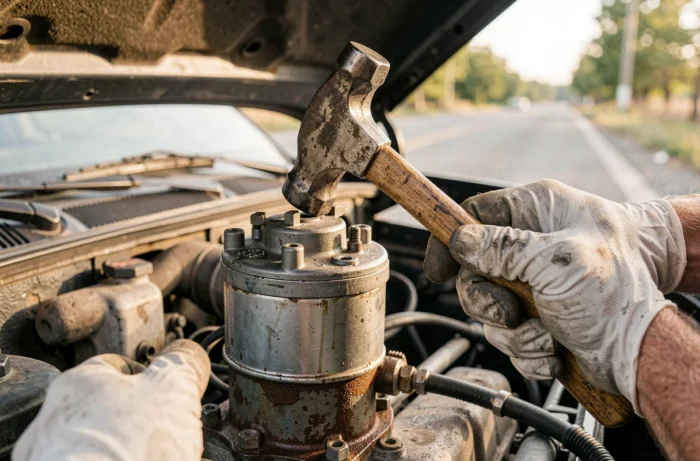
The area to aim for is the main cylindrical body of the starter, never the solenoid. The body contains the rotor, brushes, and commutator. A moderate hit on this cylinder may be enough to free stuck brushes or release a slightly jammed rotor.
- Use a screwdriver handle, a socket wrench, or a small hammer. The goal is to create a vibration transmitted to the rotor, not a violent shock that would break the aluminum housing.
- Strike two or three sharp blows on the side of the cylindrical body while an accomplice turns the ignition key. The combination of vibration + electrical impulse increases the chances of unblocking.
- Never hit the solenoid or the electrical connections. The solenoid contains fragile internal contacts, and a shock can cause a short circuit at the power terminal.
- If the starter is hot to the touch, wait for it to cool down. An overheated starter poses a risk of short circuit, a situation taken seriously by the manufacturers themselves.
Why it works (sometimes)
The starter brushes are wear parts made of graphite, pressed against the commutator by springs. Over time, graphite dust creates a deposit that can temporarily weld the brushes to the commutator. The vibration from a hit breaks this carbon bridge and restores the mobile electrical contact.
The drive gear, pushed by the solenoid via a fork, can also get stuck in the toothed ring of the flywheel. Hitting can sometimes help free it. However, if the teeth of the gear are worn or broken, no amount of hitting will compensate for the mechanical wear.
Fire risk and manufacturer recalls: what the method doesn’t say
Hitting a starter is an emergency fix, not a repair. Repeating the action on a starter that is already weakened can worsen a latent internal defect. Since 2024, massive recall campaigns illustrate this risk concretely.
BMW recalled 744,234 vehicles manufactured between July 2020 and February 2026 for an issue of internal abrasion of the starter relay. The deposits generated by this wear lead to poor conduction and a risk of short circuit, even with the engine running. Toyota launched a similar recall on the GR Supra (platform shared with BMW), recommending to avoid remote starting and not to leave the vehicle running unattended.
These recalls show that the starter is not a trivial component in terms of safety. An internal short circuit can cause a fire without warning. Hitting a starter with an already worn relay amounts to stressing a potentially dangerous component.
After troubleshooting: diagnosis and starter replacement
If hitting allowed you to start, drive directly to a garage. A starter freed by hitting will fail definitively in the days or weeks that follow. The mechanical blockage is a symptom, not the cause.
The workshop diagnosis involves measuring the starter’s current consumption and checking the condition of the solenoid, brushes, and gear. A voltage drop test on the starting circuit can also rule out a wiring issue or a defective ground, which is sometimes confused with a starter failure.
Replacing a starter varies depending on the model and accessibility of the part. On some vehicles, the operation takes less than an hour. On others, it may require removing the intake manifold or engine mount, which significantly prolongs the intervention. Having the removed starter tested on a test bench remains the most reliable method to confirm the diagnosis before ordering a new or refurbished part.