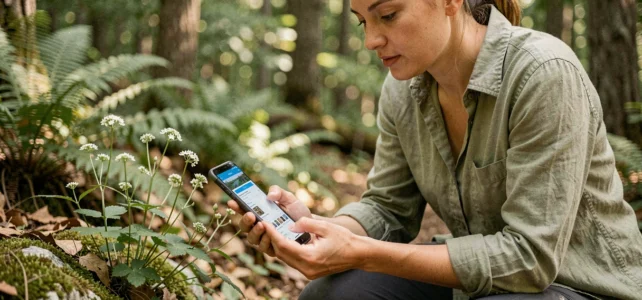
Identifying a plant found at the edge of a path or in a vacant lot is still a relatively new reflex. On Android, several free applications offer visual recognition through a simple photo, but not all are based on the same scientific foundations or business models. The choice of tool affects the reliability of the result, the protection of personal data, and the sustainability of the service.
Photo recognition on Android: what happens on the algorithm side
Most plant recognition applications operate on a similar principle: a convolutional neural network analyzes the submitted photo, compares it to a database of labeled images, and provides a list of species ranked by probability. The quality of the result depends on three factors that the user does not always control.
The first is the size and diversity of the training database. A database fed by millions of geolocated photos covers the local flora better than a general dataset. The second factor concerns the frequency of model updates: an algorithm that has not been updated for two years accumulates gaps in the face of new observations.
The third factor relates to the part of the plant photographed. Leaf, flower, fruit, and bark do not produce the same rate of correct responses.
On this last point, field feedback varies. Some users obtain reliable identifications from a single leaf, while others notice frequent confusion between closely related species when flowering is not visible. The photo of an open flower remains the most favorable case for the algorithm.
For those looking for a free application to recognize plants on Android, the choice between the different available tools benefits from being informed by these technical mechanisms rather than just a simple star rating on the Play Store.
Pl@ntNet on Android: a scientific project still actively updated
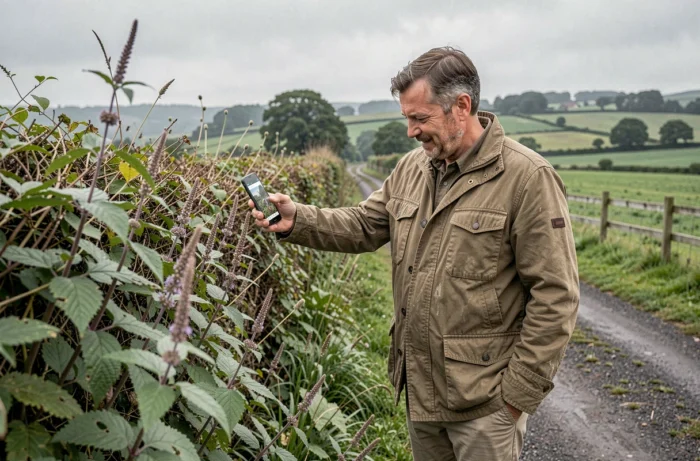
Pl@ntNet stands out from other applications due to its grounding in public research. The project is supported by French research institutes, and each observation submitted by users feeds into a database open to the scientific community. This collaborative operation explains the continuous growth of its image database.
The application will receive updates in 2025 and 2026. Versions 3.22.x to 3.26.x have brought concrete changes:
- Smoother navigation between recorded observations, with improved sorting of species proposed in the results
- Corrections of recurring bugs and refinement of translations for French-speaking users
- Optimization of the overall ergonomics of identification, particularly on the results list after taking a photo
Version 3.26.10, released in August 2026, confirms that the project remains actively maintained. This development pace contrasts with some competing applications whose last updates date back several months.
Free model and personal data
Pl@ntNet does not display ads in its basic version and does not condition access to identification functions on a subscription. The submitted photos contribute to a citizen science program, raising a legitimate question about the use of images. The collected data primarily serves to train the model and for biodiversity research.
Users who prefer not to contribute to the database can delete their observations after identification. This option is not always highlighted in the interface.
Flora Incognita: the alternative without ads or subscriptions
Flora Incognita is developed by German research teams. Its positioning differs from most competing applications on one specific point: no ads, no in-app purchases, no subscriptions. Funding relies on public research grants.
In 2026, the application benefited from documented technical improvements, particularly regarding recognition accuracy and coverage of European flora. Flora Incognita primarily targets wild plants in Europe, making it a more specialized tool than Pl@ntNet (which has global coverage).
Known limitations of Flora Incognita
The geographical specialization has a downside. Tropical or subtropical species are not covered, and the image database remains smaller than that of Pl@ntNet. For use in mainland France focused on wild plants, this limitation is not significant. However, for use overseas or during travels, the available data do not allow for reliable results.
Reliability of identification: what applications do not specify
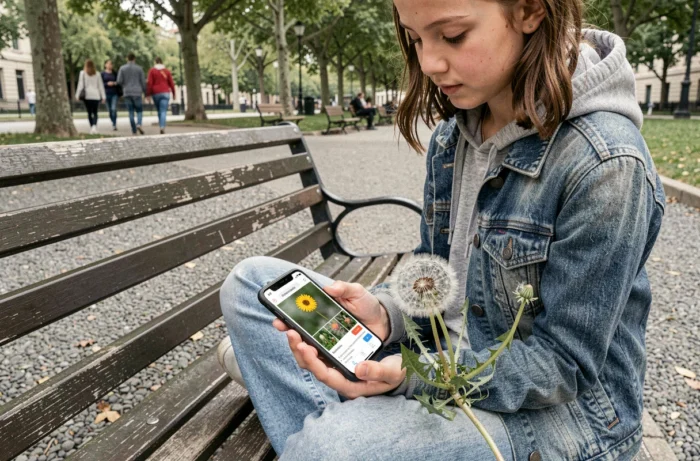
No visual recognition application guarantees certain identification. The result sheets display a confidence score, often expressed as a percentage, but this score reflects statistical proximity to the image database, not botanical certainty.
Two situations regularly pose problems:
- Plants in the vegetative stage (without flowers or fruit) frequently generate confusion between species of the same family, particularly among Apiaceae or Asteraceae
- Rare or locally under-photographed species are underrepresented in the databases, skewing the ranking of proposals
- Photos taken against the light, with a busy background, or of a damaged specimen reduce the algorithm’s ability to isolate distinctive features
For edible or medicinal plants, cross-referencing the result with a paper flora or an illustrated guide remains an essential precaution. The applications themselves usually display a warning on this point, but its visibility varies from tool to tool.
Citizen science and data quality
Applications that rely on user contributions also inherit their errors. A poorly labeled photo, validated by other inexperienced contributors, can degrade the training database. Pl@ntNet incorporates a community voting system to filter out dubious identifications, but the mechanism does not eliminate all errors.
This participatory operation creates a virtuous circle when the community is active and competent, and a vicious circle otherwise. Geographic areas with few contributing users remain the least well covered.
The choice of a plant recognition application on Android is less about design or comfort than about trust in the underlying model. A tool backed by public research, regularly updated, and transparent about data usage offers a more solid foundation than a commercial application whose business model relies on conversion to a premium subscription.