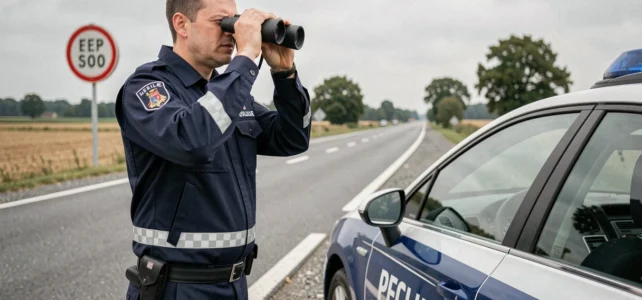
An officer stationed at the roadside points a device in your direction, and a few seconds later, you are signaled to pull over. You didn’t see any flash, no photo was taken. The question arises quickly: what is the basis for the evidence of the offense? When a speeding violation is detected by laser binoculars, the rules of the game differ significantly from those of automatic radars, and this is precisely where rights exist.
Handheld laser speed meter: what the evidence really requires
The term “twin radar” actually refers to a handheld laser speed meter. The officer targets a specific vehicle, triggers the measurement, and reads the speed on the device’s screen. No photograph is automatically generated.
This absence of an image changes everything in terms of evidence. With a fixed radar, the photo associates a license plate with a speed. With binoculars, the evidence relies on the report written by the officer. This report must mention the exact location, the time, the type of speed meter, its serial number, and the recorded speed.
When a speeding violation detected by police binoculars is noted without immediate interception, the situation becomes even more complicated. The identification of the vehicle then depends on the officer’s ability to note the license plate from a distance, without direct visual confirmation of the driver.
A rarely highlighted point: in dense areas, if several vehicles are traveling simultaneously in the laser beam, the measurement may pertain to a different vehicle than the one cited. This doubt about the individualization of the control constitutes a basis for contestation based on the presumption of innocence.
Metrological verification of the twin radar: the decisive technical point
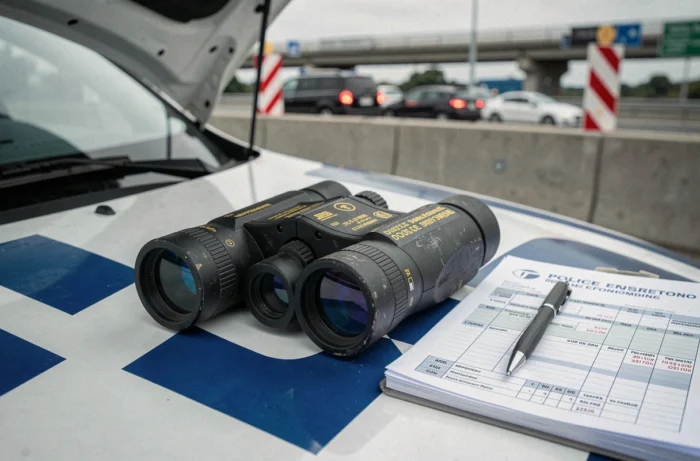
You may have heard of the “metrological logbook.” Each speed meter used by law enforcement must undergo periodic checks conducted by an accredited organization. These checks ensure that the device measures correctly.
A speed meter with an expired metrological verification does not produce admissible evidence. Jurisprudence has refined on this point: the judge no longer simply checks for the presence of the logbook. They now examine the evidence that the verification was indeed carried out within the deadlines, and that the organization that performed it is identifiable.
In practice, during a contestation, it is possible to request the court to produce the verification certificate of the device. If this document is missing or if the validity date has expired at the time of the check, the report loses its evidential value.
What the certificate must contain
- The serial number of the speed meter, which must match the one mentioned in the report
- The date of the last verification and its validity period
- The identification of the accredited organization that carried out the metrological control
If any of these elements are missing, the reliability of the measurement can be challenged before the judge.
Contesting a binocular report: exploitable procedural flaws
The metrological verification is not the only lever. The report itself must comply with mandatory mentions. Any omission in the report can constitute a procedural flaw.
Among the elements that the judge examines:
- The precise identification of the control location (municipality, road, direction of traffic, kilometer point)
- The measurement conditions: distance between the officer and the vehicle, angle of view, weather conditions
- The mention of the model and serial number of the device used
- The identity of the citing officer and their authority to observe the offense
Did you receive a notice of contravention without being stopped on the spot? The absence of interception does not nullify the report, but it weakens the identification of the driver. The holder of the registration certificate receives the notice, without proof that they were actually driving.
Interception or postal notice: two situations, two strategies
During an interception, the officer visually identifies you. They can also show you the result displayed on the speed meter’s screen, although there is no legal obligation for them to do so.
Without interception, the procedure relies on noting the license plate from a distance. The holder of the registration certificate can contest being the author of the offense by designating another driver or demonstrating that they were not behind the wheel that day. This contestation must be made within 45 days from the sending of the notice.
Technical margin and recorded speed: understanding the calculation
Each speed measurement undergoes a technical correction. For laser speed meters, this margin is defined by metrological regulations. The speed recorded on the report is never the raw speed displayed on the device: a margin of error is systematically deducted in favor of the driver.
What matters for the penalty (fine, points deduction, possible license suspension) is only the speed retained after applying this margin. If you are cited for a very slight excess, check that the margin has indeed been applied on the notice of contravention.
Controls with binoculars, less automated than fixed radars, depend more on the officer’s rigor in adhering to the measurement protocol. The position of the control, visibility, angle of view, and distance to the vehicle are all parameters that the judge can assess on a case-by-case basis. A control conducted under unfavorable conditions (heavy rain, backlighting, dense traffic) provides grounds for discussion before the police court.
The specificity of control by binoculars lies in this human dimension. Whereas an automatic radar produces a standardized file (photo, timestamp, measurement), the handheld speed meter allows for more room for assessment, and thus for contestation. Every element of the report can be examined, and every measurement condition can be questioned. It is within this margin that your rights lie.