
Women’s fashion is undergoing a period of rapid reorganization, between new European regulations on environmental claims and accelerating trend cycles. Measuring what is actually changing in wardrobes, labels, and material choices allows us to distinguish underlying movements from mere announcements.
European Regulation on Greenwashing: What Changes for Fashion Labels Starting September 2026
Most fashion blogs present seasonal trends without addressing a major regulatory turning point. Starting from September 27, 2026, the European regulation on the green transition for consumers will prohibit generic terms such as “eco-friendly,” “eco-responsible,” “sustainable,” or “green” on product sheets, labels, and marketing materials of ready-to-wear brands.
To continue using such claims, a brand will need to demonstrate excellent environmental performance with verifiable and recognized evidence, such as life cycle analyses or official certifications. Self-proclaimed labels created by the brands themselves without backing from a public certification body will also become illegal.
In practice, many women’s collections displaying pseudo-ecological logos or mentions of “responsible collection” will need to completely revise their communication. Any formulation not supported by robust data will be considered a unfair commercial practice in all circumstances.
For those interested in brands and their real commitments, it becomes relevant to discover fashion on Miss Marion to compare the approaches and ranges offered.
Environmental Claims in Women’s Fashion: Before and After the New Regulation
The table below summarizes the concrete changes that this regulation imposes on fashion brands.
| Marketing Practice | Before September 2026 | After September 2026 |
|---|---|---|
| “Eco-responsible” mention on a product sheet | Allowed without specific justification | Prohibited without verifiable proof (official certification or life cycle analysis) |
| Label created by the brand itself | Free to use | Prohibited unless backed by a recognized certification system or public authority |
| “Sustainable collection” formulation | Common in fashion marketing | Classified as an unfair commercial practice without demonstrating excellent environmental performance |
| Terms “green,” “good for the planet” | Used freely | Prohibited by default in the absence of robust data |
This framework profoundly changes the way brands communicate about their women’s collections. Female consumers who read these mentions on fashion sites will notice their gradual disappearance or replacement with precise references to third-party organizations.
Autumn-Winter Textile Trends: Materials and Colors That Structure the Season
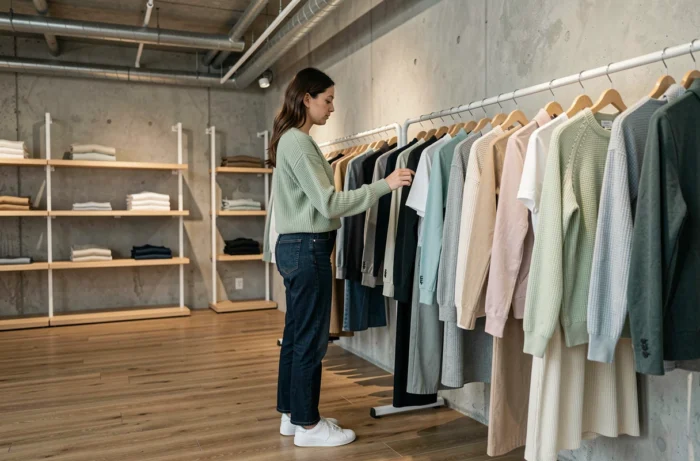
Beyond regulation, choices of materials and colors remain the concrete foundation of any wardrobe. The autumn-winter season highlights textures that play on the contrast between structured volumes and fluidity.
Thick materials (wools, dense knits, velvets) dominate the collections, while colors oscillate between muted shades and brighter accents. The red sweater, straight jeans, and reimagined suit are among the pieces making a comeback in editorial selections this year.
Criteria for Evaluating a Fashion Piece Before Purchase
- Displayed textile composition: check the exact percentage of each fiber on the label, not just the commercial name of the material
- Fabric density: a sufficiently dense weight ensures better durability over time, especially for structured coats and jackets
- Visible finishes: seams, buttonholes, partial or full linings are reliable indicators of manufacturing quality
- Consistency between price and raw material: an item sold at a high price in recycled polyester does not offer the same value for money as an equivalent in blended wool
These criteria allow us to go beyond the visual appeal of a piece to assess its actual durability, a task that is all the more relevant now that vague claims will no longer be tolerated.
Women’s Style and Freedom of Dress: The End of Age Rules
A fundamental movement is sweeping through current women’s fashion: age is no longer a relevant style criterion. The low-rise jeans worn at sixteen and the pencil skirt adopted at forty now fall under the same category of freedom of dress.
This evolution is reflected in collections that no longer segment cuts by age group. Brands offer common silhouettes, adjustable by the choice of accessories, prints, or colors. Chic style is built through the accumulation of coherent pieces, not by adhering to a generational code.
Three Axes to Assert a Personal Style
- Favor a limited color palette (three to four base shades) and add a seasonal accent, such as a print or a bright color
- Invest in basics whose cut matches one’s morphology rather than following every micro-trend
- Mix styles (casual and dressed) in the same outfit to avoid a uniform effect

This women’s fashion season can be read on two levels. The first, visible, concerns the materials, cuts, and color palettes that define the season. The second, more structural, relates to the European regulation on the green transition that will require brands to prove what they claim on their labels. This framework, applicable from September 27, 2026, could permanently change the way women’s collections are presented and marketed in Europe.