
Starting a business in France often begins with an idea scribbled on a corner of a table. Turning this idea into a viable activity requires going through specific steps, in an order that conditions what comes next. Since 2023, the administrative process has changed: all formalities go through a single online window, which simplifies the process but does not exempt one from solid project preparation.
The INPI single window, a mandatory step to register your business
Before 2023, a creator had to identify the right Business Formalities Center according to their activity (CCI for commerce, CMA for crafts, Urssaf for liberal professions). These physical counters and the old paper forms M0 or P0 are no longer usable.
Since January 1, 2023, the business formalities window (GFE), operated by the INPI, centralizes all procedures. Creation, modification, cessation: everything is done online, regardless of the sector or legal form chosen.
The registration time directly depends on the completeness of the file submitted on this platform. For a micro-enterprise or sole proprietorship, count on one to three business days if the file is complete. For a company (SAS, SARL), the process takes more like one to three weeks, as one must first draft the statutes, deposit the share capital, and publish a legal notice.
Project holders who prepare these documents in advance save considerable time on paths offered by platforms like ecostart.fr, which structure the initial steps of creation.
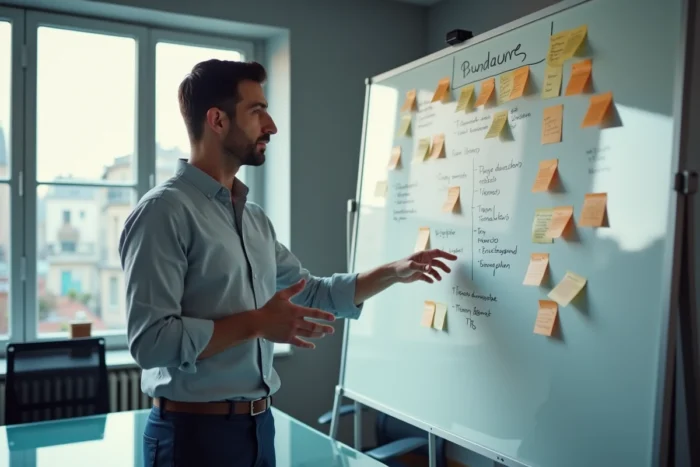
Market study and business plan: two tools that creators often rush through
Have you ever noticed how many project holders go straight from the idea to choosing the legal status? This haste explains a large part of early failures.
The market study, a filter before investing
The market study is not just about looking for numbers on Google. It involves checking three concrete things:
- Who the potential customers are, where they are located, and how much they would be willing to pay for your product or service.
- Which competitors are already occupying this niche, with what prices, what quality of service, and what exploitable weaknesses.
- What underlying trend is driving (or hindering) the targeted market, by examining local regulations and recent developments in the sector.
This work takes time. But a rigorous market study prevents investing in an activity without real demand. Testing your idea with real prospects, even informally, remains the best way to validate the business hypothesis before spending a euro.
The business plan, a document for you (not just for the bank)
The business plan quantifies your project over a minimum of three years. It forces you to answer questions that the initial enthusiasm often makes you forget: what monthly revenue covers your fixed costs? How many months can you last without income? What initial investment is actually necessary?
A solid business plan primarily serves to confront the project with financial reality. If it also convinces a banker or a funding organization, that’s a bonus. The CCIs and some support networks offer free workshops to structure this document.
Choosing the legal status: micro-enterprise, sole proprietorship or company
The legal status is not a secondary formality. It determines your tax regime, social protection, liability in case of debts, and how you can associate with others later.
The micro-enterprise is suitable for a solo activity with limited revenue. Contributions are calculated on actual revenue, not on estimated profit. This simplified regime is appealing due to its administrative lightness, but it blocks the deduction of actual expenses and imposes income ceilings.
The classic sole proprietorship (EI) allows for the deduction of expenses. Since the reform of the status, the personal assets of the manager are separated from the professional assets by default, which reduces risk in case of difficulties.
Creating a company (SARL, SAS, EURL, SASU) opens up other possibilities: welcoming partners, raising funds, adapting the manager’s remuneration according to the desired tax optimization. In return, the administrative management is heavier and the creation costs are higher.

Entrepreneurial support: the programs that really make a difference
Creating alone is possible. But supported project holders tend to structure their activity more quickly and avoid costly mistakes. However, it is essential to choose the right type of support.
- The BGE networks offer free or low-cost individual support, with training on entrepreneurial skills: management, sales, basic accounting.
- The CCIs organize thematic information meetings (financing, legal status, market study) and longer training paths for creators who want to delve deeper.
- Incubators and nurseries provide physical accommodation, mentoring, and sometimes access to investors, but generally target projects with high growth potential.
The right support depends on your stage of advancement and identified gaps. A creator who masters management but is unaware of social law does not need the same path as a project holder starting from scratch.
The development of a business in France relies less on a brilliant idea than on methodical preparation. The single window simplifies the administrative side, but the strength of the project is determined before registration: in the quality of the market study, the clarity of the business plan, and the choice of a status suited to your real ambitions.