The choice of a textile printing technique relies on technical trade-offs that most consumer comparisons only touch on superficially. The weight of the substrate, fiber composition, visual complexity, order volume, and expected lifespan interact to guide the selection of one process over another. Here, we provide a professional framework to make decisions without approximation.
Fiber and ink compatibility: the criterion that comparisons overlook
Before comparing screen printing, DTF, or embroidery, the first question concerns the composition of the textile. A sublimation polyester and a combed cotton react very differently to ink or heat. Choosing the technique before validating the substrate is like selecting a tool without knowing the material.
Sublimation only works on polyester or polyester-dominant blends. On cotton, sublimation inks do not bond with the fiber, and the print fades after the first wash. This constraint immediately rules out sublimation for any project on organic cotton or natural jersey.
DTG (Direct to Garment) yields its best results on sufficiently dense cotton. On polyester, the pre-treatment adheres poorly, and colors lose intensity. DTF (Direct to Film), on the other hand, can be applied to almost all materials thanks to its heat-activated transfer film, which explains its rise in popularity in recent years. We recommend consulting Mamzelle H’s fashion articles to delve deeper into the specifics of each process according to the type of fiber.
Embroidery remains agnostic regarding composition but requires a sufficiently structured fabric to withstand the tension of the needle without distortion. A fine fabric like modal jersey does not support a large embroidered block well.
DTF vs. screen printing: break-even point and production time
DTF is now the preferred technique for urgent orders and small quantities. The reason is simple: no printing form to prepare, no color registration for each color. A complex four-color visual is ready on film in just a few minutes, ready to be pressed.
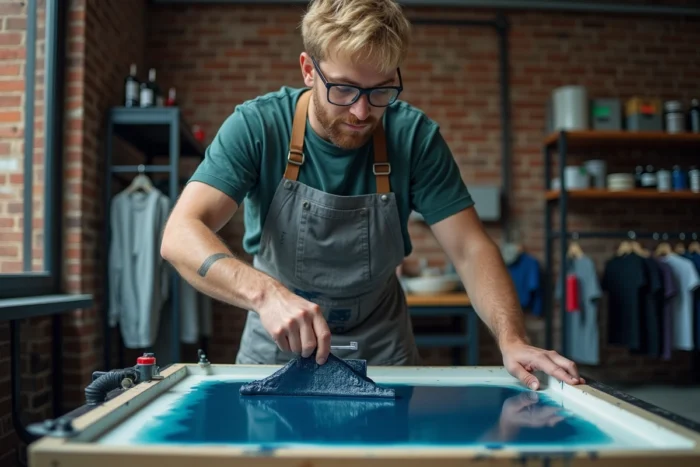
Screen printing still has a clear advantage for larger volumes. Each additional color requires a dedicated screen, which increases the fixed setup cost. However, once the screens are ready, the unit cost decreases rapidly. For a two or three-color flat design on several hundred pieces, screen printing remains more competitive.
Factors that sway the decision
- Number of colors in the design: beyond four colors or in the presence of gradients, DTF wins due to its native management of four-color printing, while screen printing multiplies screens and passes.
- Order volume: below fifty pieces, the cost of screen setup weighs too heavily on the unit price. Beyond several hundred pieces, screen printing becomes the logical choice again.
- Expected turnaround time: DTF allows for same-day production on small runs, a decisive advantage for events or quick restocks. Screen printing requires an unavoidable preparation time.
- Final touch: screen printing ink penetrates the fiber and leaves an almost invisible touch, while DTF film creates a slight thickness that is perceptible to the touch, comparable to flocking.
Embroidery on textiles: premium positioning and file constraints
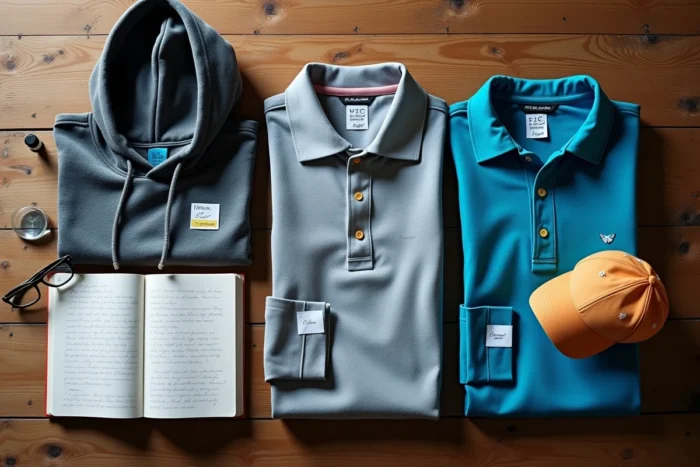
Embroidery occupies a distinct segment. It does not print; it constructs the design stitch by stitch. The raised effect, resistance to industrial washes, and high-end perception make it the default choice for durable professional clothing: corporate polos, work jackets, caps.
Companies are increasingly separating embroidery and printing within the same collection. Embroidery goes on premium, high-usage pieces, while printing (DTF, screen printing, or vinyl) is used for event or promotional textiles with a shorter lifespan. This mixed approach optimizes the budget without sacrificing brand image.
Technical limits of embroidery
The fineness of the design is capped by the thickness of the thread. A photographic gradient or text smaller than eight points does not work in embroidery. The source file must be vectorized and then converted into a stitch program, a digitization step that incurs a fixed cost. On a simple logo, this extra cost quickly balances out. For a detailed visual, it is better to switch to DTF or DTG.
The embroidered area also influences the price: a large block (full back of a jacket, for example) multiplies machine time and thus the price per piece.
Textile marking and durability: what truly withstands washes
Real durability depends as much on the process as on adherence to the pressing or polymerization protocol. A poorly pressed DTF (too low temperature, insufficient pressure) will peel off after a few cycles. A screen print whose ink has not been properly polymerized will crack at the fold.
Embroidery offers the best resistance to repeated washes, including in industrial cycles. The mass-dyed thread does not fade, and the mechanical fixation by the needle does not rely on any thermal adhesive.
DTF holds up well over time as long as the pressing adheres to the film manufacturer’s parameters. Screen printing, when done correctly, maintains its colors over a very large number of cycles, often better than DTG, which can show signs of cracking on dark solids after prolonged use.
The durability criterion is therefore not limited to the chosen technique. It incorporates strict adherence to production parameters and compatibility between ink, film, or thread and the textile composition. A workshop that masters its process will deliver a durable result, regardless of the marking chosen. The final decision rests on cross-referencing the type of substrate, volume, visual complexity, and expected lifespan of the customized garment.