Decor palettes are evolving quickly, and French interiors in 2026 no longer resemble those from three years ago. Cold gray and bright white, long dominant in magazines, are giving way to warm neutrals and earthy tones. At the same time, techniques like color drenching or the use of raw materials are redefining what it means to transform your interior without undertaking major renovations.
Color drenching: a single shade to transform an entire room
The color drenching technique involves applying the same color to the walls, ceiling, woodwork, and sometimes even the radiators. The result is an immersive atmosphere, without visual breaks between surfaces.
Designers particularly recommend it for small spaces: bedrooms, offices, hallways. By eliminating contrasts between the wall and ceiling, perceived boundaries of the space are erased. The eye no longer stumbles upon a demarcation line, creating a sense of a continuous cocoon.
In practice, this approach works better with deep shades (forest green, midnight blue, rich terracotta) than with bright colors. A hallway entirely painted in olive green, including the baseboards, creates a sophisticated effect that the same color on a single wall struggles to achieve. Those looking for more decor ideas on L’Atelier du Bricolage will find additional tips for playing with color in every room.
Color drenching also has a practical advantage: there’s no need to tape between the wall and ceiling since everything gets the same paint. Touch-ups are simpler, and the finish remains consistent even if the application lacks precision at the corners.
Trendy color palette: from greige to terracotta
In 2026, decor palettes revolve around earthy and natural shades. Terracotta, ochre, clay, and warm browns are accompanied by greens (sage, olive, forest). Neutrals are not disappearing, but they are changing in temperature: beige, sand, greige, and ecru are replacing the cold grays that dominated the previous decade.
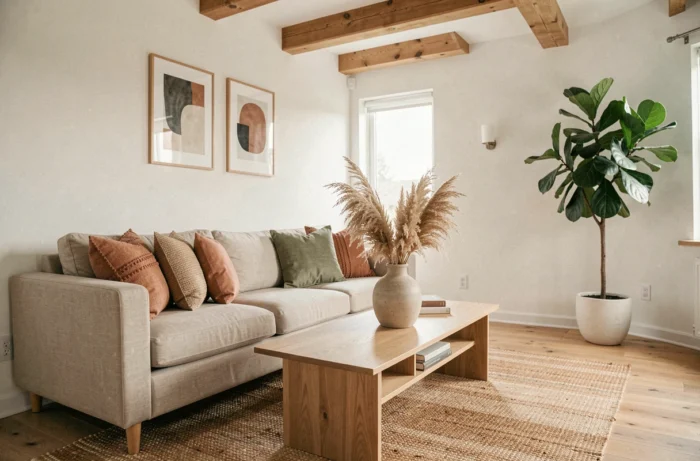
To modernize a living room still rooted in the white-gray duo, an effective first step is to replace the gray of cushions, throws, and curtains with sand or greige, then introduce a touch of terracotta through a vase, a light fixture, or a single wall. Two to three earthy shades are enough to anchor a new ambiance without overwhelming the space.
Combining earthy tones without creating a monotonous interior
The trap of natural palettes is blandness. When everything is beige, nothing stands out. The solution lies in value contrasts: pairing a dark clay wall with light wood furniture, or placing a deep ochre rug on a pale polished concrete floor.
Textiles play a relay role. A crumpled ecru linen on a terracotta sofa creates a play of texture that compensates for the absence of bright color. Field feedback varies on the interest of adding black as an accent: some decorators see it as a welcome graphic anchor, while others believe it disrupts the desired softness.
Natural materials in interior decoration: wood, stone, linen
The rise of natural materials logically accompanies that of earthy colors. Raw wood, stone, linen, lime, and rattan are no longer confined to country interiors. They can be found in urban apartments, paired with black metal or concrete.
- Raw wood (oak, walnut, ash) adds warmth and ages well, provided you choose a finish suitable for the use: oil for a countertop, wax for a decorative shelf.
- Natural stone (travertine, veined marble, slate) works in small touches (console tops, coffee table trays) to avoid a massive effect in small spaces.
- Linen and lime, used respectively in textiles and wall coatings, introduce irregular textures that break up the smoothness of contemporary interiors.
The benefits of these materials go beyond aesthetics. A lime plaster naturally regulates ambient humidity, making it a relevant choice for wet rooms or poorly ventilated bedrooms. Linen, for its part, is distinguished by its durability and its appearance improves with washing.
Design furniture 2026: soft curves and artisanal pieces
Furniture is following the same trajectory as colors: softening lines and a return to manual craftsmanship. Rounded shapes (sofas with curved armrests, tables with curved edges, oval mirrors) dominate recent collections. This trend responds to a weariness of strictly geometric lines that characterized Scandinavian design in the 2010s.
Recycled or second-hand wooden furniture is also gaining ground. Scoring an antique dresser and refinishing it yourself allows for a unique piece at a cost often lower than that of a new mid-range piece. The result adds character, where a set purchased all at once from the same store produces a homogeneous but flat interior.
What decor objects really change the atmosphere of a room
Not all accessories have the same visual impact. Three categories of objects significantly alter the perception of a space:
- Lighting fixtures: a woven rattan pendant or a brushed brass floor lamp transforms the lighting and style of a living room faster than a sofa change.
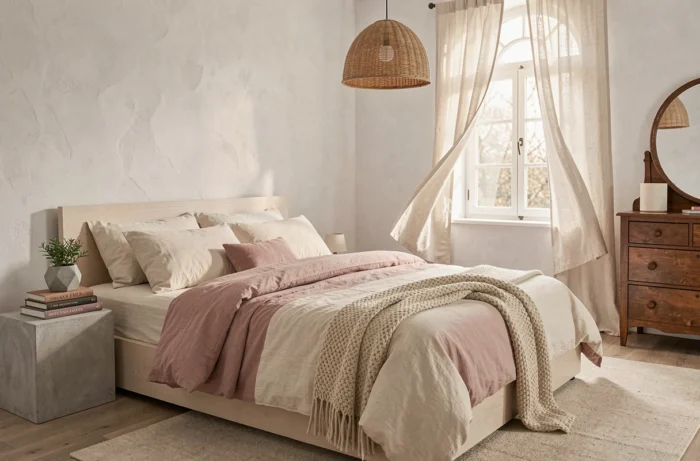
- Voluminous textiles: a thick linen bed throw or heavy washed cotton curtains add depth and absorb sound, which also changes the acoustic ambiance.
- Large mirrors: placed on the floor or fixed opposite a window, they redistribute natural light and visually enlarge the room.
Focusing on these three levers rather than accumulating small decorative objects produces a clearer result. An interior gains personality with fewer pieces, but better chosen.
Renewing an interior does not necessarily require heavy renovations. A lime plaster on a wall, a change of light fixture, a palette refocused on sand and terracotta tones: these targeted interventions are often enough to radically change the atmosphere of a living space. The challenge is not technical; it mainly lies in the coherence of choices between colors, materials, and volumes.