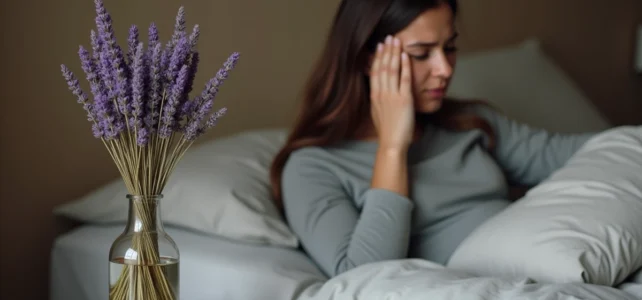
Lavender is associated with calm, restorative sleep, and fresh sheets. A sachet slipped under the pillow, a few drops of oil on the pillowcase, a diffuser running all night. These actions may seem trivial. They are not always, especially in a closed space like a bedroom.
Linalool and terpenes: the active molecules that raise questions
Have you ever noticed that a bottle of lavender essential oil often states “contains linalool”? This compound, along with other terpenes like limonene, gives lavender its characteristic scent. It is also classified as a contact allergen by European cosmetic regulations.
In a ventilated living room, the concentration remains low. In a closed bedroom of a few square meters, at night, the air quickly becomes saturated. Nasal and bronchial mucous membranes absorb these molecules for several hours in a row.
The public database of medicines from ANSM indicates that the presence of lavender essential oil and its terpene derivatives in a pediatric ointment is associated with a risk of seizures in infants and children, with a recommendation not to use it in children under six years old. This well-documented neurological risk for medications is rarely applied to pillow mists and diffusers sold in wellness aisles.
A detailed article explores the dangers of lavender in the bedroom from the perspective of endocrine disruptors, an additional aspect to consider.
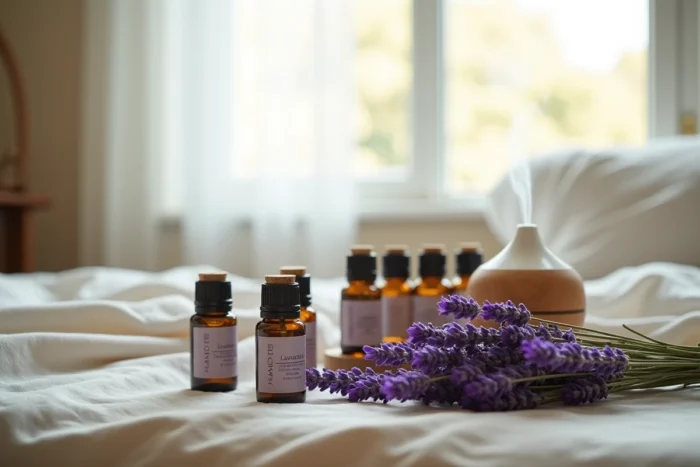
Nocturnal diffusion of lavender: why duration changes everything
The common reflex is to turn on the diffuser at bedtime and let it run all night. Aromatherapy professionals advise against this practice. Their recommendation is based on a simple principle: diffuse thirty minutes before bedtime, then turn off and ventilate.
Why this threshold? Beyond a certain concentration in the air, essential oils irritate the respiratory tract instead of soothing it. Asthmatic or allergic individuals are the first affected, but waking up with a dry throat or morning headaches can concern anyone.
Sprays and pillow mists: the same logic
A lavender spray applied to the bed releases its molecules all at once. The face then rests directly on the treated area. The best practice is to spray the linen, then ventilate the room a few minutes before going to bed. The fragrance remains present, but the concentration of terpenes in the air drops to a level that is manageable for the bronchi.
Lavender in the bedroom and European regulation: the CLP regulation under revision
Lavender essential oils are under scrutiny by European authorities. The revision of the CLP regulation (classification, labeling, packaging) is examining the possibility of classifying certain lavender oils as potentially hazardous substances under endocrine disruptors.
If this classification goes through, the affected products (pillow mists, scented candles, diffusers) will need to carry modified labeling. Some may be withdrawn from the market or reformulated. The lavender industry is closely monitoring this issue, as the impact would affect both producers and manufacturers of bedroom products.
For consumers, the lesson is already clear: a “natural” product is not automatically risk-free. Lavender contains dozens of active compounds that interact with the body.

Children, pregnant women, and animals: the profiles to protect as a priority
The room of an infant or young child is not the right place for a lavender diffuser. The immature nervous system of young children reacts differently to terpenes. ANSM reminds us of this for topical medications, and the logic also applies to prolonged inhalation in a closed space.
Pregnant women represent another sensitive profile. Specialized aromatherapy guides recommend avoiding most essential oils during pregnancy, including true lavender.
Cats and dogs: a sensitivity often overlooked
Cats metabolize phenolic and terpenic compounds very poorly. An active diffuser in a room where a cat sleeps can cause long-term liver problems. Dogs tolerate these molecules better, but continuous exposure is still not recommended.
Here are the situations where caution is particularly warranted:
- Room of a child under six years old: no diffusion of lavender essential oil, even briefly, without medical advice
- Room shared with a pet (especially a cat): prefer a sachet of dried flowers placed out of reach rather than a diffuser or spray
- Room without proper ventilation: if the window cannot be opened after diffusion, it is better to abstain
- Asthmatic person or someone suffering from respiratory allergies: first test a very short diffusion during the day, in a ventilated room
Concrete alternatives to keep lavender without the risk
The goal is not to banish lavender from the bedroom. It is to adapt the form and dose to the context.
Dried flowers in a sachet remain the safest option. They release a minimal amount of volatile compounds, far too low to saturate the air. A sachet in the clothing closet repels moths without exposing the respiratory tract.
For the bed, a drop (not three, not five) of essential oil on a tissue placed away from the face, on the nightstand for example, provides a perceptible scent without excessive concentration. Direct contact with the pillowcase multiplies exposure.
- Sachet of dried flowers in the closet: effective against moths, without respiratory risk
- One drop of essential oil on a support distant from the face: scent present, concentration controlled
- Limited diffusion to thirty minutes, window open afterwards: a compromise between olfactory benefit and safety
Lavender in the bedroom is not a problem in itself. The problem is the dose, the duration, and the lack of ventilation. A sachet of flowers in the clothing closet and systematic ventilation after any diffusion are enough to enjoy the scent without turning the room into a respiratory trap.