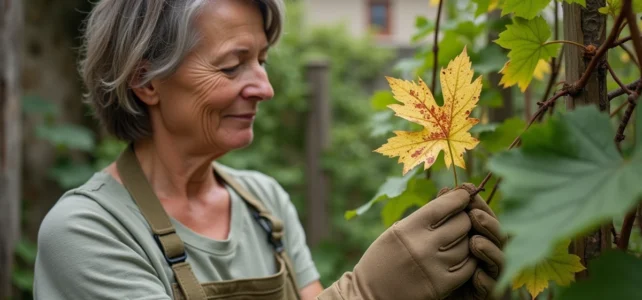
Downy mildew, powdery mildew, gray rot: these three names come up every season in the concerns of gardeners who cultivate table grapes. Identifying the disease responsible for the spots on the leaves or clusters is not enough. The choice of treatment, its timing, and the applied dose determine both the effectiveness against the fungus and the long-term impact on the soil.
This article compares the main treatment options available for a garden, distinguishing their conditions of use and limitations.
Downy mildew, powdery mildew, and black rot: comparison of symptoms and treatments
Before spraying anything, the correct diagnosis must be made. The three most common fungal diseases on garden vines are distinguished by specific visual symptoms on the leaves, berries, and wood.
| Disease | Symptoms on leaves | Symptoms on berries/clusters | Common treatment | Main limitation |
|---|---|---|---|---|
| Downy mildew | Yellowish oily spots on the upper side, white down on the underside | Drying and browning of the clusters | Copper (Bordeaux mixture) | Accumulation of copper in the soil |
| Powdery mildew | Gray-white powder on both sides, deformation of the leaf blade | Berry splitting, grayish down | Wettable or powdered sulfur | Leaf burns beyond high temperatures |
| Black rot | Brown spots circled with black dots | Black mummification of berries | Removal of affected organs, preventive fungicide | No effective curative once the berries are affected |
This table summarizes the standard approach. However, it masks a point that most guides overlook: the frequency of treatment depends more on the weather than on a fixed schedule. A rainy episode followed by mild temperatures triggers rapid sporulation of downy mildew, while a dry week makes any spraying unnecessary.
To delve deeper into each protocol, you can treat grapevine diseases by following a dedicated guide that details dosages and key phenological stages.
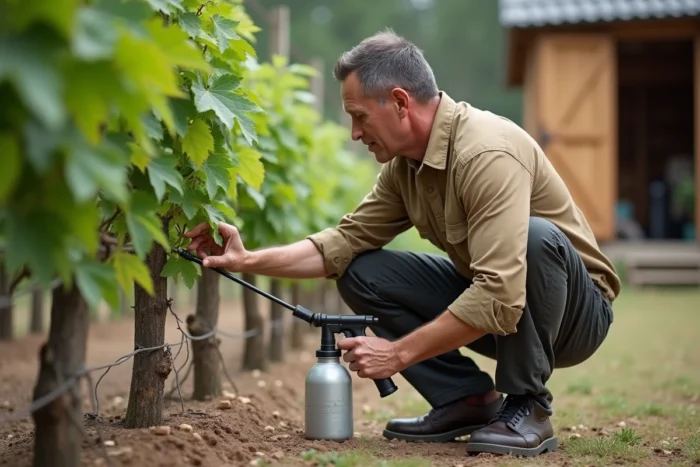
Copper in the garden: why reduce doses on vines
The Bordeaux mixture remains the number one reflex against downy mildew. Its preventive effectiveness is real, but it poses a problem that amateur gardeners underestimate.
Copper does not degrade in the soil. Each application adds a layer of metal that accumulates year after year. In France, technical organizations now recommend a strong limitation on the use of copper, particularly for individuals, due to its impact on soil fauna (earthworms, microorganisms).
Reducing copper does not mean giving up on protecting the vine. Several levers allow for decreasing the quantities sprayed:
- Treat only when weather conditions require it (prolonged leaf wetness duration, rain forecast) rather than at fixed intervals.
- Combine copper with approved biofungicides, such as potassium bicarbonate or preparations based on microorganisms, to space out copper applications.
- Adapt the volume of the mixture to the actual leaf surface: a young trellised vine does not require the same amount as a vine in full production.
This logic of risk-driven treatment, common in professional viticulture, also applies to a single vine in a garden. Observing the local weather over three rolling days provides a better indicator than any printed schedule.
Biofungicides and biocontrol: concrete alternatives for table grapes
The trend for 2025-2026 in leisure viticulture confirms a partial substitution of traditional treatments with biocontrol products. The term encompasses very different realities, and not all are equal.
Potassium bicarbonate against powdery mildew
Potassium bicarbonate modifies the surface pH of the leaves, which limits the germination of powdery mildew spores. Its toxicological profile is favorable, and it can be used close to harvest. It does not replace sulfur in high-pressure situations, but it allows for reducing the number of sulfur applications over the season.
Microbial preparations and plant extracts
Some biofungicides based on microorganisms (antagonistic fungi or bacteria) are beginning to be approved for garden use. Their mode of action relies on biological competition: they colonize the leaf surface before the pathogen.
Their effectiveness remains lower than that of copper or sulfur in cases of high fungal pressure. They find their place in a strategy of alternation, where each application of biofungicide postpones the next spraying of copper or sulfur by a week.
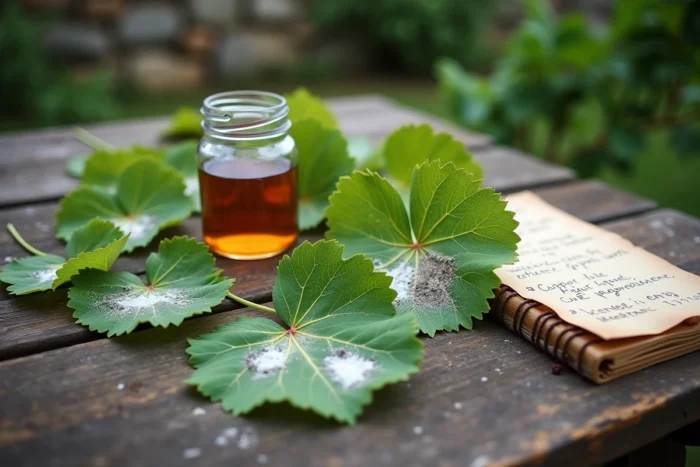
Managing vine treatments by weather rather than by calendar
Classic guides indicate to treat “every ten to fourteen days.” This frequency does not take into account the climatic reality of a given season. In modern viticulture, including for small plots, the decision to treat relies on three measurable parameters.
- The duration of leaf wetness: downy mildew needs several hours of wet foliage to infect. Without this condition, preventive spraying can wait.
- The average nighttime temperature: powdery mildew develops mainly between 20 and 30 degrees with moderate humidity, not in the rain.
- The rainfall history over the week: a succession of rainy days justifies an anti-downy mildew treatment even if the last application was recent.
Consulting local weather forecasts three times a week and observing the state of the foliage each morning remains the most reliable method for adjusting the frequency of treatments. A preset pressure sprayer and a tracking notebook (date, product, weather conditions) transform a reactive gardener into a preventive gardener.
Grapevine disease in the garden cannot be fought with a single protocol repeated year after year. The precise visual diagnosis of symptoms on leaves and clusters guides towards the right product, and the local weather dictates the right timing. Reducing copper, integrating biofungicides, spacing applications when the risk is low: these adjustments protect both the harvest and the soil that supports it.