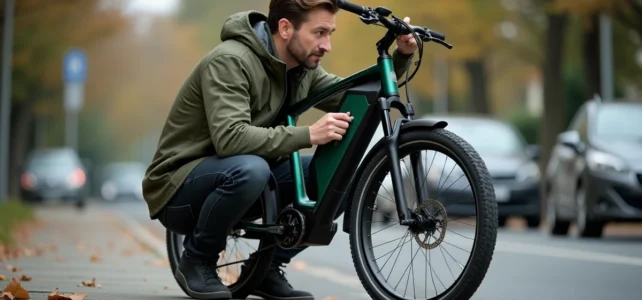
An electric assist bike from Decathlon that refuses to start or whose assistance cuts out while climbing poses a real problem: should you intervene yourself, contact customer service, or go directly to the workshop? The answer depends on the type of malfunction, and especially on the initial diagnosis that the cyclist is able to make before any manipulation.
Error codes and LED indicators: what the electric bike’s screen really displays
Before disassembling anything, the first step is to read what the bike communicates. The Rockrider, Riverside, and Elops models from Decathlon display error codes on the screen or via the dashboard LEDs. A flashing “E” indicator, for example, signals a fault detected by the controller, not necessarily a serious malfunction.
Each code corresponds to a specific component: pedal sensor, battery-motor connection, or controller overheating. The reflex to adopt is to note the exact code before turning off the bike. Some codes disappear after a simple restart, while others persist and require intervention.
The site support.decathlon.fr offers diagnostic sheets by model, with exploded views and video tutorials. Searching for the exact model (Elops 920 E Connect, Rockrider E-ST 500, etc.) provides access to much more precise protocols than generic guides. Identifying a fault on a Decathlon electric bike always starts with this careful reading of the screen and the manufacturer’s manuals.

Battery and charger: electrical diagnosis before any manipulation
The battery accounts for the majority of reported faults on Decathlon e-bikes. The symptoms are similar (decreasing range, bike that won’t turn on, intermittent assistance), but the causes vary.
Check the contacts and locking
A poor connection of the battery in its housing is enough to cut off the power. Dirty or oxidized connectors cause random cuts in assistance, often mistaken for a motor failure. Removing the battery, cleaning the contacts with a dry cloth, and then firmly repositioning it resolves a significant proportion of these incidents.
Test the charger independently
A faulty charger simulates a battery failure. The charger’s LED should turn green once charging is complete. If it remains red all the time or does not light up at all, the problem lies with the charger, not the battery. Decathlon offers charger replacement as a standard service in the workshop.
Key point to remember: never attempt to reset a lithium-ion battery without the manufacturer’s protocol. Disconnecting and reconnecting internal connectors without knowing the wiring can damage the BMS (Battery Management System) and void the warranty.
Pedal sensor and motor: when assistance cuts out for no reason
Assistance that cuts out while riding, works in fits and starts, or does not trigger at all points to two distinct components.
The pedal sensor (or cadence sensor) is a magnetic disc located at the crankset. If it shifts by a few millimeters or if a magnet comes loose, the controller no longer detects pedaling and cuts off assistance. Visually checking the alignment of the disc and the gap with the sensor is a manipulation accessible without specific tools.
The motor itself rarely fails abruptly. The symptoms of a failing motor are gradual:
- Unusual grinding or clicking noise when assistance starts, indicating a worn gear in the case of a crank motor
- Constant loss of power across all assistance modes, even with a full battery, which points to a controller problem rather than a motor issue
- Total lack of response after checking the battery, charger, and sensor, which justifies a visit to the workshop for a complete electrical test
Decathlon workshop: e-bike services and handling process
Decathlon has structured a network of workshops with services specific to electric bikes, bookable online. The process is standardized: choose the store, make an appointment, diagnosis, quote, and then repair.
The e-bike revision service includes a complete electrical diagnosis (battery test, connector check, motor and sensor control). Technicians have proprietary diagnostic tools for Decathlon ranges, which is not the case for all independent workshops.
Some elements to prepare before going to the workshop:
- The error code displayed by the screen or LEDs, noted precisely (letter and number)
- The battery fully charged to allow for testing under real conditions
- Proof of purchase if the bike is still under warranty, as some electrical faults (controller, BMS) fall under the manufacturer’s warranty
Warranty and spare parts
Electrical components (battery, motor, controller, screen) have a warranty distinct from that of the frame. Keeping the purchase receipt and the bike’s serial number speeds up the handling process. Spare parts specific to Decathlon e-bikes (sensors, battery barrel, chargers) are listed on the site and can be ordered in-store.
When faced with a fault on an electric bike, haste often leads to unnecessary or risky manipulations. A methodical diagnosis (screen, battery, sensor, motor, in that order) allows for the elimination of simple causes before engaging in costly repairs. The model sheets from support.decathlon.fr remain the most reliable starting point, far ahead of general forums.