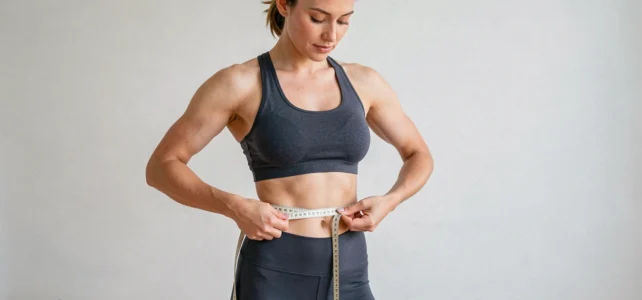
Ordering pants online and returning them because the fit doesn’t match one’s body shape is a situation we all know. The problem doesn’t lie with the garment, but with the gap between a standardized size (S, M, L) and the reality of a body. Creating a virtual silhouette based on one’s actual measurements helps bridge this gap, provided one understands where the real friction points are.
Measurement Accuracy: What Causes Modeling Failures
Most guides explain how to take measurements. Few mention that the position of the measuring tape changes the entire result. A hip measurement taken two centimeters too high creates a virtual silhouette that corresponds to no commercially available garment.
Three areas regularly pose problems when taking measurements for a body avatar:
- The bust measurement, often taken too low or too high relative to the nipple line, which skews the width of the torso on the 3D model.
- The waist measurement, reflexively taken at the navel, while the natural waist is located at the narrowest point of the torso, sometimes several centimeters above.
- The inseam, difficult to measure accurately alone, but crucial for the length of pants on the avatar.
To limit errors, measurements should be taken standing, in underwear, with feet together, and without holding one’s breath. The measuring tape must be parallel to the ground for horizontal measurements. Getting help from someone significantly reduces discrepancies.
Before launching a modeling tool, one can create their virtual silhouette with their measurements by following a rigorous measurement protocol, which avoids having to repeat the process three times.
Virtual Silhouette Tools by Measurements: What Works in Practice
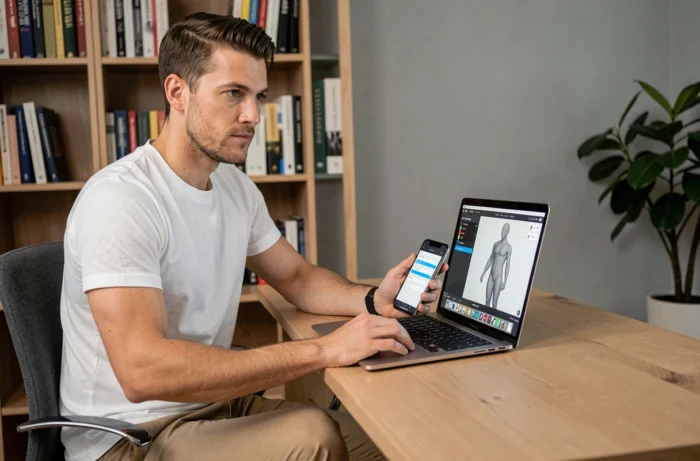
There are two main categories of tools. On one side, mobile applications that use the smartphone camera to scan the body in two poses (front and profile). On the other, online visualizers where one manually enters their measurements (height, weight, bust, hips, inseam).
Smartphone Camera Scanning
Applications like Nettelo allow users to generate a 3D avatar from two photos taken with a smartphone or tablet. The software automatically calculates the measurements and displays a three-dimensional model that can be rotated. The measurement is quick, but the accuracy depends on the lighting and neutral background behind the user.
In a busy background or a dark room, the software confuses the body’s contours with the environment. Feedback on this point varies depending on the phone model used.
Manual Entry Visualizers
Tools like HowHeight’s Body Visualizer work differently. Users input their height, weight, bust, waist, hips, and inseam. The visualizer generates an adjustable 3D figure. The advantage: one can compare two silhouettes side by side, for example, before and after weight gain or loss.
Manual entry remains more reliable if the measurements are taken correctly, as it does not depend on the camera quality. However, it does not capture body asymmetries that a scan detects.
Virtual Silhouette and Online Fitting: The Real Impact on Returns
The main interest in having a digital avatar that accurately reflects one’s body shape is to reduce unpleasant surprises upon receiving an order. Recent sector analyses show that virtual fitting based on measurements reduces returns by 20 to 40% compared to orders without preview.
This figure is significantly higher than what simple size conversion charts offer, which only marginally decrease returns. The reason is simple: a chart translates a bust measurement into a letter (M, L), while an avatar shows how the garment falls on a silhouette with exact proportions.

Several brands are now integrating these technologies directly into their online virtual fitting rooms. The customer inputs their measurements or sends their photos, and the site displays the garment on their digital twin before purchase.
Body Shape and Avatar Limitations: What a 3D Model Doesn’t Show
A 3D avatar based on six or seven measurements remains an approximation. It reproduces the major proportions of the body, not the details that influence how a garment falls:
- The curvature of the back and posture (rounded back, shoulders forward) change how a jacket closes at the front.
- The distribution of muscle mass relative to fat mass alters the perceived volume at equal measurements.
- Sloping or square shoulders influence the width of a top much more than just the bust measurement.
An avatar does not replace physical fitting for structured pieces like a blazer or fitted coat. For a t-shirt, straight jeans, or a flowy dress, however, the virtual silhouette provides a reliable indication.
Technologies are evolving towards more comprehensive scans, incorporating posture and localized volumes. The extended reality market applied to retail is pushing the creation of virtual silhouettes towards increasingly mainstream uses, which should improve accuracy in the coming years.
The starting point remains the same: correctly taken measurements are better than the best poorly fed algorithm. Before testing a tool, invest five minutes with a measuring tape and a trusted person. The rest will follow.