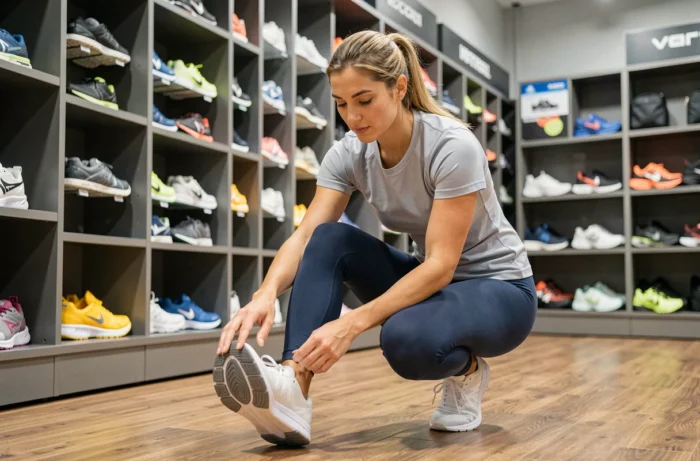
A runner who is starting out on the road with overly rigid trail shoes often ends up with shin pain within a few weeks. Choosing sports equipment is not just a matter of budget or brand: it is primarily about matching the gear to actual practice. Adapting each piece of equipment to the terrain, body type, and training frequency remains the best way to avoid injuries and improve.
Compliance and traceability: what the European GPSR regulation changes
Since December 13, 2024, the General Product Safety Regulation (EU) 2023/988 applies to all non-food consumer products sold in Europe, including sports equipment. It is rarely mentioned in buying guides, but this regulation significantly changes how to identify a reliable product online.
The regulation requires that an economic operator based in the European Union be identifiable for each product. The product sheet must display the manufacturer’s name, a physical address, safety warnings, and technical documentation including a risk analysis. Equipment sold on a marketplace without this visible information does not comply with the legal framework.
In practice, when comparing two pairs of running shoes or two bike helmets on a retail site, the quality of the product sheet becomes a sorting criterion. You can explore sports equipment on 1 Sport 1 Coach to identify references with documented traceability. A manufacturer that clearly displays its certifications and contact details inspires more confidence than an anonymous brand offering an abnormally low price.
Sports shoes: three criteria that matter more than the brand
We are often asked which brand to choose. The real question concerns three technical parameters that determine comfort and injury prevention, regardless of the brand.
Type of stride and cushioning
A pronator runner does not need the same support as a supinator. Most specialized stores offer a gait analysis on a treadmill. If you run less than twice a week, a versatile model with standard cushioning is sufficient. Beyond three outings per week, cushioning suited to your weight and stride reduces the risk of injury.
Practice surface
Road shoes lose all grip on a muddy trail. Conversely, trail spikes wear out on asphalt within weeks. It is beneficial to have two distinct pairs if you alternate surfaces, rather than a “versatile” model that does neither correctly.
Fitting at the end of the day
The foot naturally swells throughout the day. Trying on shoes in the morning results in a size that is too tight for an afternoon training session. It is recommended to leave half a centimeter in front of the toes, measured while standing and bearing weight.
Protective gear and helmets: safety standards before design
For personal protective equipment (bike helmets, shin guards, boxing gloves), the PPE regulation 2016/425 governs the marketing within the European Union. All protective equipment must bear a CE marking corresponding to its risk category. Without this marking, the product simply does not belong in a shopping cart.
A bike helmet that has suffered an impact, even without visible cracks, loses some of its absorption capacity. The internal foam compresses irreversibly. It should be replaced after any significant impact, not just when it shows visible damage.
- Check the CE marking and reference to the applicable standard (EN 1078 for bike helmets, EN 13277 for boxing protections, for example).
- Check the manufacturing date: protective materials degrade over time, even without use. Beyond five years, opinions vary on residual reliability, but replacement remains prudent.
- Prefer a snug fit without compression: a helmet that moves on the head does not provide proper protection during a lateral impact.
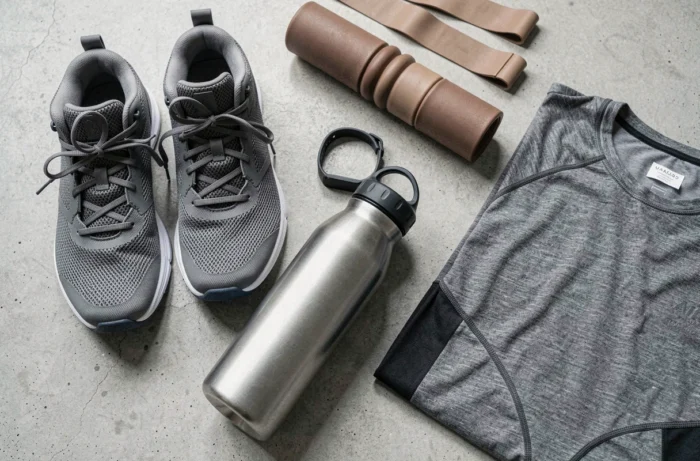
Technical clothing: material and fit above all
Cotton remains the worst choice for prolonged effort. It absorbs sweat, dries slowly, and causes friction irritation. Synthetic fibers or merino wool wick moisture and regulate body temperature much more effectively.
You do not need a complete wardrobe to start. Two technical tops, a pair of shorts or leggings suitable for your sport, and a windbreaker cover most situations. The three-layer system (breathable base layer, insulating layer, protective layer) works well for running, hiking, or cycling.
The fit deserves as much attention as the material. An overly loose shirt creates friction under the arms or at the seams. A garment that is too tight compresses the muscles and hinders breathing. Trying on while simulating the sports gesture (raising arms, bending knees, leaning) helps identify constraints before purchase.
Training equipment: choose versatility over quantity
Accumulating specific equipment for each exercise fills a garage without improving results. For home training, a few versatile pieces cover nearly all needs.
- A pair of adjustable dumbbells replaces a dozen fixed weights and allows for progressive loading over several months.
- A sufficiently dense exercise mat protects the joints for yoga, core work, and bodyweight exercises.
- Resistance bands of varying levels provide a complete muscle workout, from light strengthening to intense physical preparation.
Before buying, ask a simple question: will this equipment be used at least twice a week? If the answer is no, it will end up under a bed.
The choice of sports equipment is based on measurable criteria: regulatory compliance, suitability for practice, quality of materials. Checking for a CE standard or analyzing your stride takes a few minutes but avoids weeks of downtime due to injury. Better to have three well-chosen pieces of equipment than a closet full of impulsive purchases.